


Mempool.space: Reduce Your Bitcoin Transaction Fees

Many Bitcoin network users think a transaction costs more than $30. This misconception comes, without a doubt, from exchanges such as Binance, which charge between $20 and $30 to withdraw your precious satoshis.
As I write these lines, mining fees range from $0.07 to $0.70 per transaction. How do I know? I watch the Bitcoin network’s mempool in real time.
The mempool.space website scans the block-building process in real time and lists all pending Bitcoin transactions. It helps you choose an appropriate transaction fee based on network congestion.
In this article, we’ll cover:
- Tips for paying low fees,
- How the transaction-fee auction works,
- The features of the mempool tool,
- BONUS: An explanatory video in French (by DécouvreBitcoin)
Once you’ve read this article, you’ll never again accept the default fees suggested by your wallet—and you’ll save precious fractions of a bitcoin!
1. A quick refresher on fees and mining
Before optimizing our fees, we need to understand where they come from. They play a very specific role in the organization and security of the network.
A) Where do network fees go, and what are they for?
It’s worth remembering that transaction fees are part of the mining reward process, which helps secure the network.
The Bitcoin blockchain consists of thousands of blocks that record new transactions. A new block is added about every ten minutes and can contain only a limited number of transactions.
This deliberate limit keeps the blockchain lightweight, allowing anyone to store the transaction ledger. Today, it keeps the entire Bitcoin network’s blockchain to just 415 GB. This limit contributes to its decentralization and broad accessibility.
Fees also act as an anti-spam filter for the network. A malicious actor trying to fill every block would have to pay substantial transaction fees.
B) How are they calculated?
The order in which transactions are processed, and the fees they pay, are determined through a large auction system.
Miners choose the order in which they validate transactions. To increase their mining rewards, they prioritize transactions according to the fee paid.
Because this is an auction, fees vary according to how keen users are to make transactions. When the network is temporarily congested, transaction fees have sometimes risen above $30.
In that situation, it’s worth reconsidering how quickly you need your transaction to go through. No one is forcing you to outbid others with high fees. You can place your transaction at the bottom of the queue and wait an hour, a day, or even a week.
2. Using and understanding mempool.space
Every morning, part of my routine is to visit mempool.space and check for myself that the Bitcoin protocol is working properly. I also check it before signing every transaction, so I can choose a fair transaction fee. The site gives you a real-time overview of the Bitcoin network and block production.
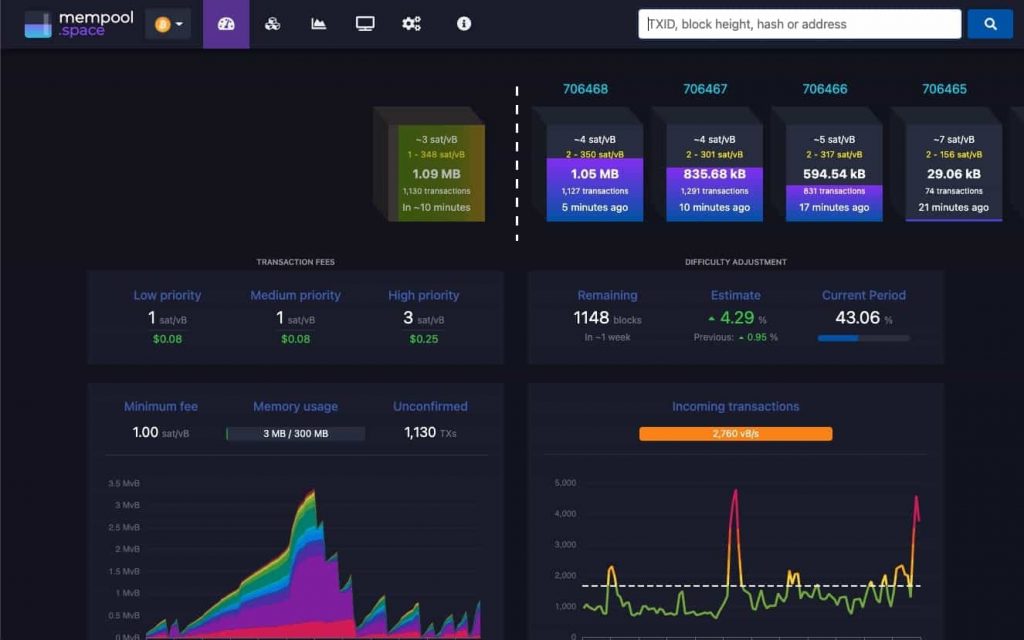
All this data may look complicated at first glance, but it’s actually quite easy to understand.
A) How Bitcoin blocks are built

To the left of the dotted line, you can see the upcoming blocks currently being assembled. As soon as a miner validates a new block, it is numbered and joins the previously mined blocks to the right of the dotted line.
Note: Remember that all the information shown on blocks being prepared is provisional. Until your transaction is definitively confirmed, it can still be moved to another pending block.

The first label on each block shows the fees paid by users. For example, “~3 sat/vB” is the fee rate that would have been enough for a transaction to be included in block 706 472. We can also see that the fees paid ranged from 2 to 201 sat/vB. A fee of 201 sat/vB seems wildly excessive. Even if you want your transaction confirmed quickly, there’s no need to overbid that much to get in first.
The bold number in the center of each block indicates that block’s weight.
You can easily see how old mined blocks are from the “x minutes ago” label on each one.
B) Estimating transaction fees
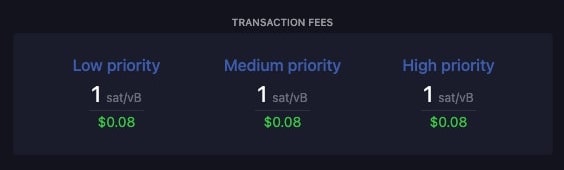
This part of the site suggests a fee rate based on the priority you want.
In this example, the newly mined blocks aren’t completely full, so there’s no need to outbid others. I therefore recommend setting your sending fee to 1 sat/vB.
The dollar estimate shown by this tool is based on an average transaction weight. If your transaction is particularly large because it involves many inputs, your fees may be slightly higher.
Comparison: If you buy oranges, the price depends on the price per kilogram, but also on how many oranges you buy. Bitcoin works the same way: your transaction fee depends on the price per unit of transaction weight (sat/vB), as well as the transaction’s own weight (vB).
Bonus: Understanding the mempool in depth
- An article in English on analyzing the memory pool in depth.
- A video in French from the Découvre Bitcoin channel: