


Scaling Bitcoin with STARKs? Starknet CC Conference
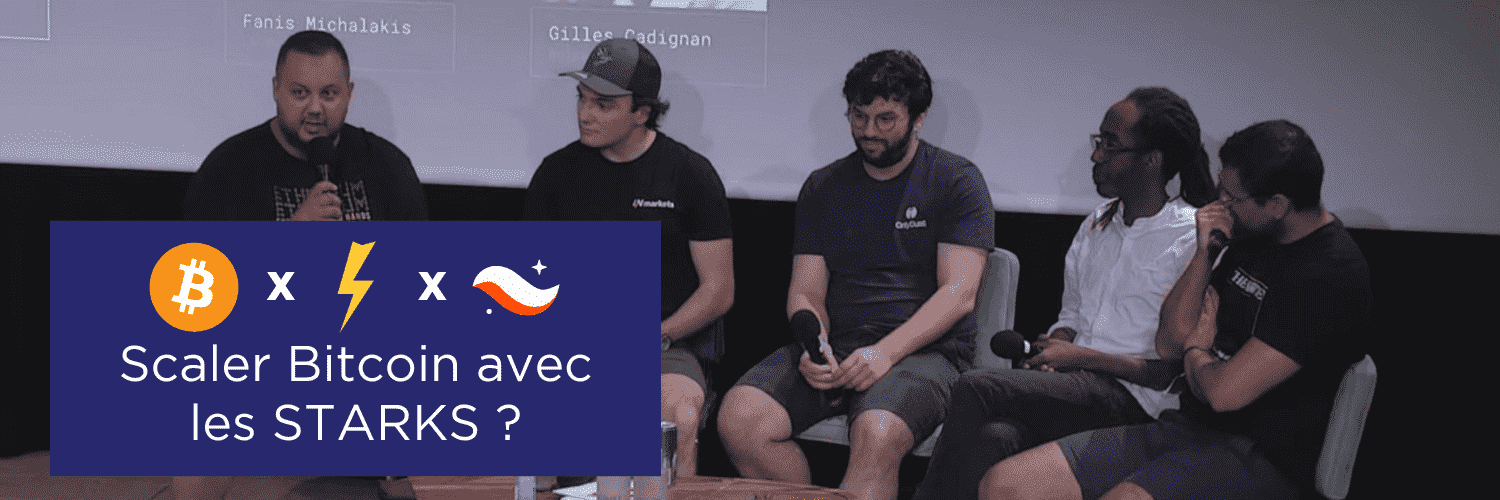
This article covers the main ideas from the “Scaling Bitcoin with STARKS?” panel held at the Starknet CC conference in Paris on July 22, 2022.
Panel speakers:
Abdel: StarkNet Ecosystem Lead at StarkWare, and former Ethereum Core developer behind EIP-1559.
Fanis Michalakis: Lightning Network specialist, working at LNMarket (a Bitcoin derivatives trading platform on the Lightning Network).
Tarik: Works at OnlyDust, a platform in the StarkNet ecosystem.
Gilles Cadignan: CEO of Woleet, known as a staunch Bitcoin maximalist.
Louis Guthmann (moderator): Ecosystem Lead at StarkWare.
What are the characteristics of an ideal L1 settlement layer: BTC vs. ETH?
According to Gilles, Bitcoin’s primary purpose is to exchange value over the internet. Bitcoin is a protocol that ossifies over time thanks to its conservative policy, whereas Ethereum faces many hard forks. A layer 1 protocol’s primary goal should be stability and compatibility between versions.
For Abdel, a layer 1 must operate without interruption and resist censorship. In theory, that makes Bitcoin the best settlement layer, but unlike Ethereum, it is not designed for that today. Solana is ruled out because of its network’s lack of stability.
Abdel later raises two long-term concerns for Bitcoin: low fee levels and a lack of resistance to quantum computers. In his view, STARKs could help address these issues.
Gilles then jokes that altcoiners are very concerned about Bitcoin’s future problems while underestimating the current problems facing their own cryptocurrencies. Gilles prefers to focus on present-day problems and wait until future problems materialize before dealing with them. He recommends that Ethereum users address their current problems.
The difference in mindset between building on BTC and ETH
Gilles recalls that, in Ethereum’s early days, the idea was to do everything on-chain. The vision of multiple layers has always existed in Bitcoin. In his view, executing off-chain and verifying on-chain is indeed the best way for Ethereum and Starknet to scale.
Gilles points to an issue of “time preference” among altcoiners. As a Bitcoiner, he prefers “Fix the money first”, and notes that there is still work to do on that front. A monetary protocol cannot develop rapidly, and the focus should be on its “streaming of value” function. The rest can come later. Later in the panel, Abdel and Tarik say they agree with the “Fix the money first” mindset.
At the end of the discussion, Tarik elaborates on his vision of Bitcoin and Ethereum as complementary. One would solve monetary problems, while the other would enable programs to run. Their use should be combined insofar as they develop interconnected ideas: a way to exchange money securely and build a new financial system.
What makes a good L2?
According to Gilles, sidechain-based L2s developed quickly on Bitcoin but saw very little adoption. RSK is an EVM-compatible Bitcoin sidechain, but nobody uses it. The Liquid sidechain has yet to find its audience and remains little used. Gilles notes that the Lightning Network is not a sidechain, but a permissionless protocol. Lightning would therefore be the only true layer 2 protocol, comparable to TCP as a layer 2 protocol for IP. According to this view, Ethereum would have no real layer 2 protocol.
For Louis, L2s should focus more on self-custody than on being permissionless. He is willing to use a centralized L2 if he is guaranteed that he can retain control of his funds if something goes wrong.
Gilles replies that, under this view, L2s depend on the companies that develop them, and those companies will not all do things in the same way. In his view, a protocol should instead be developed as a set of rules anyone can implement. Lightning would be a good layer 2 because it provides low-cost scaling and focuses on money.
Can Bitcoin be changed to build L2s on top of it?
Abdel argues that changes to the Bitcoin Core protocol would be needed to develop performant L2s.
Fanis replies that this would mean a soft fork and immediately rules out the hard-fork route. In his view, it would require broad support from the “plebs” (Bitcoiners), expressed through the developers’ mailing list and social networks such as Twitter. Fanis notes that there is no vote on Bitcoin, but users must signal their support. Without support from Bitcoiners, there can be no proposal.
Gilles adds that reaching consensus among Bitcoin developers is very difficult, and recommends against considering changes to the base protocol. Reaching consensus requires political and media influence.
Could Bitcoin have DeFi like Aave?
In response to Louis’s question, Fanis says Aave could be possible on Bitcoin, but built in a different way. He qualifies his answer, however, by saying he is not sure Bitcoiners would be interested. The issue is more philosophical than technical.
Would Starknet on Bitcoin be a more elegant layer 2 than RGB and LN?
Abdel and Gilles agree that they are both skeptical about the RGB layer 2. Abdel thinks this solution will take too long to become operational and suggests turning instead to StarkNet. It is already a “live” solution, whereas RGB has no proof of concept and will ship directly as a final release. In his view, STARKs are an interesting avenue to explore for enabling Bitcoin to scale hyper-efficiently. He also considers ZK-Rollups much purer and more elegant than the Lightning Network.
Gilles then raises the possibility of combining the two to create a powerful solution. Abdel agrees and says an elegant way to bring them together will have to be found.